

The Moat Is Draining
BIG Idea Future Report • Bill Bishop's BIG Idea Future Network • March 5, 2026

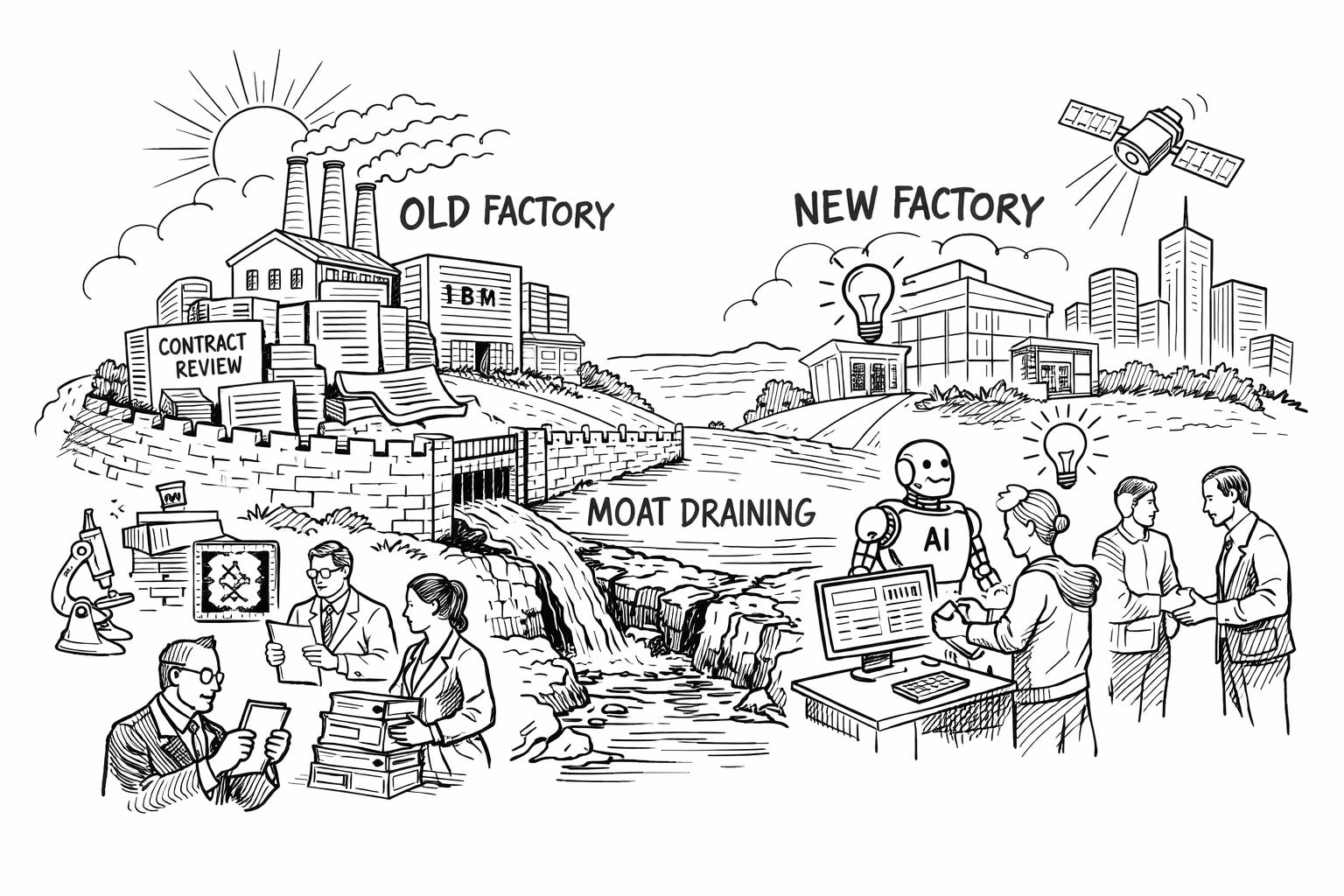
A few years ago, I was speaking at a legal conference in Toronto. Before my talk, I had breakfast with a senior partner at one of the city’s largest firms. He was proud, and rightly so. His firm had built a formidable reputation over decades. The associates were brilliant. The clients were loyal. The revenues were impressive.
“What’s your biggest profit center?” I asked him.
He smiled. “Due diligence and contract review. We can put twenty associates on a transaction and bill it out at several hundred dollars an hour each. Clients pay it because they have to.”
I nodded. “And what happens when AI does that in four minutes for four dollars?”
He looked at me like I’d just suggested the sun might not rise tomorrow.
That breakfast was three years ago. Today, I’d wager he’s not smiling quite as broadly.
The Old Factory Was Built on Scarcity
Here’s the pattern I want you to see, because once you see it, you can’t unsee it.
For the last fifty years, some of the most profitable businesses in the world were built on the same basic foundation: scarcity of expertise, complexity of process, or asymmetry of information. These were the moats. The deeper the moat, the higher the fees. The higher the fees, the more powerful the business.
IBM understood this before almost anyone else. They didn’t make money selling computers. They made money by becoming so embedded in their clients’ operations that switching was unthinkable. The moat wasn’t the product. The moat was the switching cost, the complexity, and the certified expertise required to make it all work.
AI is systematically draining every moat built on those three foundations.
And it’s doing it fast.
The Industries Being Repriced Right Now
Let me walk you through what I’m watching, industry by industry, because the scope of this is extraordinary.
Big law firms built empires on document review, due diligence, and contract analysis. Junior associates billing hundreds of hours to read through discovery documents was a profit center. AI does that work in minutes. Firms that charged $50,000 for a contract review are watching that number collapse. The moat was the billable hour. The billable hour is evaporating.
Radiologists spent a decade in training to read scans. AI now matches or exceeds their accuracy on certain diagnoses. When expertise becomes abundant and cheap, the entire pricing structure of that specialty gets renegotiated. The scarcity was the moat. The scarcity is gone.
H&R Block and the big accounting firms built their businesses on the complexity of tax codes and the scarcity of people who understood them. AI turns that expertise into a commodity. The person who needed a $400 accountant can now get equivalent guidance for almost nothing.
SAP, Oracle, and Salesforce all have massive consulting ecosystems built around the complexity of implementing their own software. The fact that it was hard, and required certified specialists, was the moat. AI agents are beginning to automate the implementation work that armies of consultants used to do.
Cybersecurity firms built their moats on the scarcity of security expertise and the complexity of threat detection. When Anthropic announced Claude Code Security capabilities recently, CrowdStrike and Okta both took immediate hits in the market. That’s not coincidence. That’s the market repricing a moat it suddenly sees differently.
An entire industry of professional translators and localization agencies had a moat built on linguistic scarcity. That moat is largely gone.
Real estate brokers and mortgage underwriters had moats built on access to information and the complexity of the transaction. AI is attacking both simultaneously. The information asymmetry that made brokers essential is shrinking fast.
Universities had a moat built on being the exclusive gateway to certain knowledge and credentials. When AI can teach, assess, and in some cases substitute for the credential itself, that gateway loses power.
Market research firms that charged significant money to run focus groups, analyze consumer behavior, and produce research reports are watching those deliverables produced in hours by AI at a fraction of the cost.
The pattern is identical in every case.
Any business where the value was stored in human scarcity, process complexity, or information asymmetry is vulnerable. Not eventually. Today.
Now You Might Say...
“Bill, this is alarmist. These industries have survived disruption before. Lawyers survived word processors. Accountants survived spreadsheets.”
Fair point. And I’d agree, if this were another productivity tool. But it isn’t. Word processors made lawyers faster at drafting. Spreadsheets made accountants faster at calculating. AI doesn’t make lawyers faster at document review. AI doesthe document review. That’s a categorically different thing.
The printing press didn’t make monks faster at copying manuscripts. It made the monks irrelevant for that specific task. The monks who survived were the ones who figured out what they could do that the press couldn’t.
That’s where we are.
The New Factory Is Built on Abundance
This is the heart of New Factory Thinking.
The Old Factory was built on scarcity — scarce expertise, scarce access, scarce information. The more scarce, the more valuable. That logic held for decades. It no longer holds.
The New Factory is built on abundance. AI makes expertise abundant. Information is abundant. Processing power is abundant. In a world of abundance, the premium goes to something different.
It goes to what remains irreducibly human.
Judgment. Not just analysis, but the wisdom to know which analysis matters. Relationships. Not just communication, but the trust built over time between two people who have been through something together. Accountability. Not just output, but someone whose name is on it, who stands behind it, who you can look in the eye. Creativity at the edge. Not recombination of existing patterns, but genuine imagination about what’s never existed before.
AI sorts data; humans add meaning. AI produces documents; humans make decisions. AI processes information; humans build trust.
That’s your new moat.
The Questions Worth Asking
If you’re an entrepreneur reading this, here are the questions I’d want you to sit with:
Where in your business is the value stored in your expertise, your process complexity, or your information advantage? Be specific and be honest. Because if the value lives there, AI is coming for it.
What do your clients actually pay you for that has nothing to do with information transfer? What do they pay you for because you are you — because of your judgment, your relationships, your accountability?
What would your business look like if everything AI can do, AI already does — and you are only doing the things AI cannot?
That last question is the one I find most useful. It has a way of clarifying things quickly.
The Bright Future and the Dark Future
The bright future looks like this: entrepreneurs who understand this pattern rebuild their value proposition around human irreducibles. They use AI to do the commodity work faster and cheaper than anyone else, and they free up their time and attention for the work that only humans can do. They become more valuable, not less, because they’ve combined AI’s abundance with human judgment. Their clients get better outcomes. Their businesses become more profitable with fewer hours.
The dark future looks like this: entrepreneurs who ignore the pattern keep building businesses on expertise moats that AI is draining. They compete on price because they don’t know how to compete on anything else. They work harder for less. Their scarcity advantage evaporates, and they have nothing to replace it with.
The dark future isn’t inevitable. But it is the default path if you don’t act on this.
One Thing You Can Do This Week
Take your current service offering and ask yourself one simple question: what percentage of what I currently do could AI do adequately, if not better?
Be ruthless. Don’t protect your ego. Just estimate the percentage.
Then ask: what’s in the remaining percentage?
That remaining percentage is your New Factory.
Everything else is an old moat in a world that’s figured out how to drain it.
The water is already moving.

Are you ready to create your BIG Idea and build your New Factory?
BOOK a free BIG Idea Session with Bill Bishop
During the 60-minute session, Bill will use New Factory Thinking™ to help you create your special BIG Idea: something new, better and different to take your business to the next level.
Using your new BIG Idea, you will stand out in your marketplace, attract more high-quality prospects, sell higher-profit premium products and services, and use emerging technology to build the future business of your dreams.
Book your free session using this link


LINDY: Use Lindy to create AI Agents

SYNTHESIA: Use Synthesia to create AI-generated videos

LOVABLE: Use Lovable to create AI-generate apps

LOVART: Use Lovart to create AI-generated graphics
FYXER: Use Fyxer to automote your business operations

WISPR FLOW: Use Wispr Flow to eliminiate typing and empower AI-empowered dictation


BILL BISHOP is the CEO of The BIG Idea Company and the founder of The BIG Idea Future Network. He helps forward-thinking business leaders create BIG Ideas and build the future business of their dreams. He is the author of 11 books, including How To Sell A Lobster, The New Factory Thinker, and Dancing With Robots. He is also an international keynote speaker.
Excellent summary of the situation.
Having done so many process consultations, I totally get the redundancy. And the opportunity to discern what it means now to be human. Judgment. Signal vs noise. Accountability. Emotional regulation under pressure. Emdodied meaning making vs words regurgitated.